Dear Betty, Dearest Grace
Why friendship is important for creative women

Elizabeth Maconchy and Grace Williams are, unambiguously, two of my favourite composers. They have such different styles — Maconchy is austere and completely uncompromising, Williams brings DRAMA. But both have a captivating energy and fire in their writing. (If you want a taster, try Maconchy’s symphonic poem The Land, based on Vita Sackville-West’s poem, or Williams’ Sinfonia Concertante for piano and orchestra.)
So I was delighted to find out that not only were these two women best friends, but they wrote to each other, prolifically, through the entirety of their decades-long friendship. And the letters are wonderful. They give a dynamic impression of these composers’ personalities at their most unrestrained. They discussed everything, from music to jam, and at the heart of their correspondence is a deep respect and support for one another’s work. When one of Maconchy’s ballets was criticised for being too “difficult”, Williams encouraged her to keep going nonetheless:
You mustn’t bother your head any more, my girl, about writing safe scores. It doesn’t become you. Besides it isn’t necessary: your difficult things always come off best. (11 Feb. 1935)
When one of Williams’ pieces was rejected by a Fund set up ‘for the encouragement of native composers’, Maconchy replied in kind, assuring Williams that her work wasn’t at fault:
I am furious about the Patron’s Fund. It is absolutely mad to have rejected your Psalms. Who can they have to select the things? […] It is dreadful that such a laudable (& expensive) scheme should be so wasted — & not only wasted but perverted and misapplied. (24 Feb. 1932)
Anyone who does any kind of creative work will recognise this flavour of message. Friendly reminders that your work is worth doing, and that not every application is going to get a yes, is vital to push through the rejections and disappointments that are part of the everyday business of a creative career. And Maconchy and Williams needed this support from each other more than most, because they were women trying to build musical careers in twentieth-century Britain. They experienced far more setbacks than men of a comparable stature. They rarely discussed gender explicitly, but it’s always there, in the background, when Maconchy’s talking about juggling childcare with work, or when they’re considering how to navigate the informal “one-piece-by-a-woman” limit in a concert series. This was Maconchy’s advice to Williams regarding the Proms:
I think I should tell him [conductor Henry Wood] bout your piano concerto & the other things, as well. He might not do 2 piano concertos by women composers! (18 Feb. 1942)
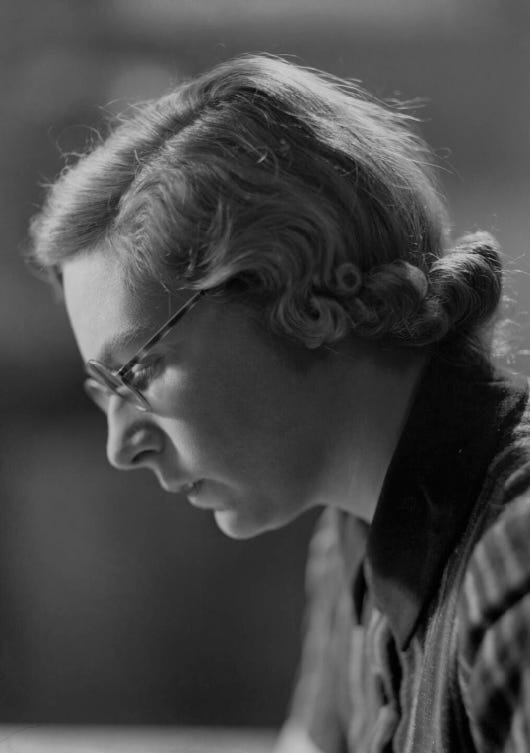
In 1933, both composers entered the same chamber music competition by the Daily Telegraph, and Maconchy’s Quintet won a prize (third) while Williams’ Sextet did not. Still, Williams wrote joyfully to her friend to applaud her success. This letter and the competition that sparked it are really revealing, because they show Maconchy and Williams at the heart of a British musical scene that has largely disappeared from the record now:
How HEAVENLY! – ! When I got your postcard I felt convinced you’d got 1st prize. It didn’t enter my head – not for a moment – that it could be anything but first […] However £75 will be very nice for you & then your quintet will be broadcast – I’m longing to hear it – I howled when I read that it was ‘young man’s music’ didn’t you? […] I wonder whether the oboe quartet was Benjamin [Britten]’s. He’s away for the weekend so I can’t ask him. – I am just a bit jealous of the other sextet. My heart missed a beat when I read about it. – Piano & wind – & then a full stop. But no strings (& I had 3) mentioned – and the description did so fit most of my thing it was nothing but a string of tunes which I wrote mostly when I was sunbathing – nevertheless lots of my first & last mvts. were a bit fiery – so – I have a nasty little serpent within me when I think of this other person’s sextet – but it will soon be subdued. (c. 13 Mar. 1933)
There’s so much in this letter. First, I love that Williams is so candid about her response to somebody else’s sextet doing better than hers (the ‘nasty little serpent’!), and that she wrote half of her piece while sunbathing. Second, there’s the acknowledgement of sexism lingering in the response to Maconchy’s piece, then brushing it off with a slightly irritated humour that was totally characteristic of both composers.
Third, there’s the network of British composers that floats in the background of this letter. The other prize-winning composers were Cecil Armstrong Gibbs and Edric Cundell, both for string quartets that were subsequently recorded by the Griller Quartet (alongside Maconchy’s Quintet). Yet neither composer is particularly heard of now, showing just how complex and capricious the process of historical record formation can be. Formal recognition in a composer’s lifetime doesn’t guarantee them posthumous fame — Cundell was awarded a CBE for his services to music, while Maconchy received a Damehood and Williams turned down her OBE. Nor was publication a guarantee of success. Much of Gibbs’ large output was published, ranging from operas through a choral symphony to songs. By comparison, Maconchy and Williams fared very poorly indeed when it came to publication, especially of larger works. But they are now benefitting from efforts to redress historical prejudice against music by women. And in Williams’ case, attention has also been drawn to her work by initiatives in Wales to celebrate music by Welsh composers, so both are performed more frequently now than either Gibbs or Cundell.
The only name from this competition that really stuck was Benjamin Britten (whose student piece came commended). To be remembered, a composer has to be in the right place at the right time with the right style, right personality, a particular identity, and access to a network of supporters with money and contacts. Britten was that one composer in mid-twentieth-century Britain, but the reality of musical life in that period was so much richer and varied than is allowed by narratives that reduce British music-making to a neat line leading from Vaughan Williams to Britten alone. When we accept this story and flatten complexity, we miss out on a lot of fantastic music and also make it harder to learn anything from the past. If we want to know why Britten became the British composer of this period, it isn’t enough to say that his music was good. There were many composers writing good music. Their work got forgotten. Truly understanding Britten’s success — and how society decides what artistic work to value — needs an explanation that goes beyond the notes.

By the 1930s, Vaughan Williams was the composer in whose shadow all others stood. This was especially true for Maconchy and Williams, who had been his students. They deeply admired “Uncle Ralph”, as they referred to him, but were frustrated by the way their music was constantly compared to his, especially when their styles were so radically different. Even if critics were determined to hear their early work as ‘Vaughan-Williamsian’, Williams and Maconchy were treading quite separate paths to their teacher. They were able to take an unsentimental critical attitude to his work — as they did to each other’s. When Maconchy heard Vaughan Williams’ Fifth Symphony in 1943, she wrote:
I listened to Uncle Ralph’s new Symphony […] & I think it is very beautiful in a quiet way. There is nothing new in it — & very little incident or even outstanding material […] rather as if he was ruminating over the bits of his own music that he likes best. It certainly has his own kind of beauty in it, that no-one else gets. (7 Jul. 1943)
It was an astute judgement, appreciating what is best about Vaughan Williams’ work without pedestalising him. Williams was slightly more direct in her evaluation after he criticised Maconchy’s ballet Agrippa, which Williams particularly liked (even though Vaughan Williams was a friend, nobody was safe from Williams’ withering putdowns). But she still pointed to something important about the way he composed, and revealed a lot about her own compositional style and sympathies in the process:
Now Uncle Ralph is a dear we all know, but he’s got a great bee in his bonnet about one thing — he always turns his deaf ear to works which are brilliantly effective. Think of what he said about “Sacre”! — & even worse things about “Wozzeck”. […] The great fault of Uncle Ralph’s scores is, to my mind, that there is too much thematic material going on at the same time & that so often the rhythmic balance is all wrong & sounds muddled. […] The amazing thing bout the Schönbergians is that however complicated their rhythmic patterns are, they always hang together & fit. Poor Uncle Ralph — I hate having to say that there’s anything wrong with him — but he does bring it on himself when he says such things about a work like Agrippa. (after 11 Feb. 1935)
Propulsive rhythms, brass foregrounded in the orchestral texture, and extensive use of percussion give Williams’ music a biting, acerbic quality that is quite distant from Vaughan Williams, even at his most experimental. She was also taught by Austrian modernist Egon Wellesz, whose work and outlook influenced her, and her music is perhaps most closely aligned to Shostakovich, Sibelius and Bartók. Williams and Maconchy show the difficulty of trying to categorise twentieth century music, especially, by national borders. Beyond Williams’ use of Welsh folk tunes it’s very difficult to point to anything more broadly that would mark her music as distinctly “Welsh” or indeed “British”. As for Maconchy, she was Anglo-Irish, both lived and studied in Ireland and England, and her style and outlook were just as international as Williams’.
These letters tell us so much about musical life of this period, but I value them most for the beautiful, searingly honest insight they give into these composers’ lives. Their friendship survived a world war, illness, parenthood, marriage, professional triumphs and setbacks, and they shared all of this with one another. For over fifty years, they gave each other a space to express self-doubt and try out new ideas, relying on one another for honest feedback and direction in both their personal and professional lives. It was rare to find a friendship like that. When Williams found out she was dying, she wrote to Maconchy from her hospital room to bid farewell. ‘I’ve had the great good fortune to be able to respond to so many wonderful things,’ she said. And one of the most wonderful of those things was Maconchy herself. ‘I’ve believed in your genius ever since our college days,’ Williams wrote. ‘Our friendship has been one of my rarest & most precious blessings.’
‘Music, Life and Changing Times: Selected Correspondence Between British Composers Elizabeth Maconchy and Grace Williams, 1927-1977’ is published by Routledge, edited by Sophie Fuller & Jenny Doctor.
This is so interesting and very moving. Thank you for a great read, Leah.
This is such beautiful writing. Thank you for bringing these composers to life!